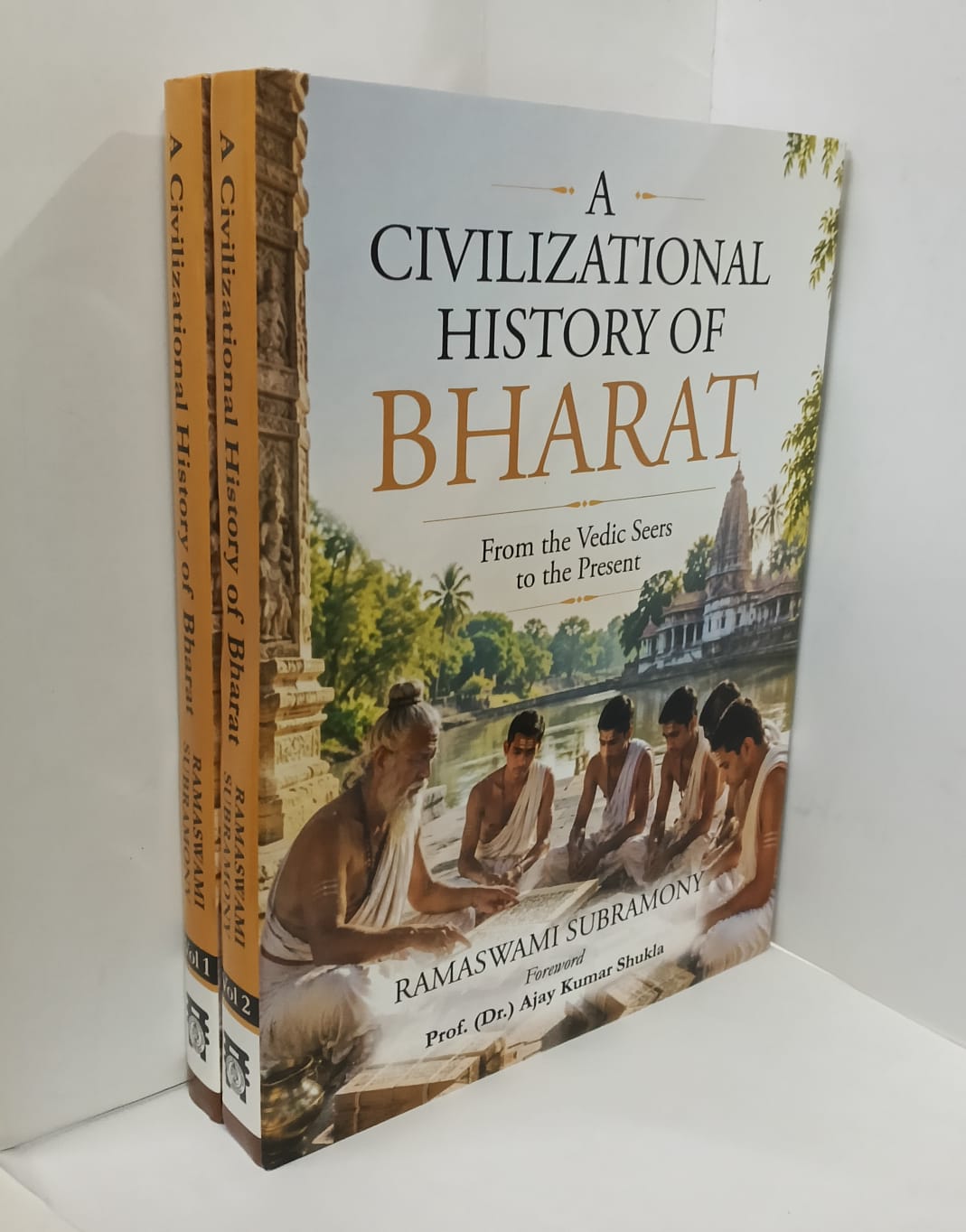
A Civilizational History of Bharat: From the Vedic
Seers to the Present is a sweeping narrative of one of the world’s oldest
living civilizations. Spanning from the age of the Vedic Rishis to contemporary
India, this book traces the evolution of Bharat’s intellectual, spiritual,
social, and cultural traditions through the institutions, texts, teachers, and
lineages that preserved and transmitted its civilizational ethos across
millennia.
Drawing upon the Vedas, Brahmanas, Upanisads,
Itihasas, Puranas, Dharmasastras, inscriptions, Sangam literature, temple
traditions, and the works of major philosophers and saints, Ramaswami Subramony
presents a comprehensive account of the continuity of Bharatiya civilization.
The book explores the growth of Vedic learning, the guru-sisya tradition, the
development of philosophy, literature, ritual, education, Science, temple
culture, kingship, and the enduring contribution of great acaryas and spiritual
leaders from every region of Bharat. Rather than viewing Indian history as a
series of disconnected political events, this work interprets it as the
unfolding of a living civilizational consciousness rooted in Dharma, knowledge,
and cultural continuity. It examines periods of flourishing, adaptation,
challenge, and renewal, while highlighting the remarkable resilience of India’s
intellectual and spiritual heritage.
Written in an accessible yet scholarly style and
supported by an extensive bibliography, A Civilizational History of Bharat is
an invitation to rediscover the ideas, institutions, and personalities that
have shaped Bharat’s civilizational mind from antiquity to the present. It is
an essential resource for scholars, students, and the readers interested in
understanding the historical foundations of one of humanity’s most enduring
civilizations.
Volume-I
1. The Rigvedic Dawn and the Emergence of the Brahmana
2. The Sacred Geography of the Brahmana: From Gandhara to Mithila and the South
3. The Brahmana in the Ramayana and the Mahabharata: Dharma’s Compass in the
Age of Kings
4. Brahmanas in the Ramayana: The Sacred Presence of the Twice-Born in
Valmika’s Civilizational Epic
5. Brahmanas in the Mahabharata: Spiritual Authority and the Moral Architecture
of the Epic Age
6. The Central Brahmana Sages of the Mahabharata
7. The Brahmana as Educator, Storyteller, and Custodian of Civilizational
Memory in the Mahabharata
8. Brahmanical Authority as The Backbone of Governance in The Mahabharata
9. The Brahmana in the Upanishads: The Seer of the Self, the Guardian of Inner
Light
10. The Brahmana and the Fire Within: From Sruti to Sraddha
11. Where Silence Speaks: The Inner Landscape of the Upanishadic Brahmana
12. The Brahmana in the Puranic World: Mapping Sacred India Through Memory,
Myth and Time
13. Brahmanas in the Puranas: Custodians of Cosmos, Time, Genealogy, Ritual,
and Civilizational Memory
14. The Great Brahmana Rsis of the Itihasa-Purana Age: Architects of Sacred
Knowledge and Civilizational Foundations
15. Brahmanas Across Regions: From Gandhara to Kanyakumari, A Pan-Indian
Civilizational Presence
16. The Brahmana and the Circulation of Knowledge Across the Subcontinent
17. The Brahmana in the Classical and Early Medieval Age: Civilization,
Kingship, and the Age of Temples
18. The Brahmana and the Golden Age of Universities and Temples
19. The Brahmana and the Institutional Foundations of Indian Civilization
20. The Brahmana, Land Grants, Temple Economics, and the Governance of Learning
21. Universities of Ancient India: The Age of Scholarship, Discipline and
Civilizational Light
22. The Brahmana and the Manuscript Civilization: Libraries, Scriptoria, and
the Preservation of Knowledge
23. The Brahmana as Scientist: Astronomy, Mathematics, and the Sacred Precision
of Knowledge
24. Temple-Universities: The Brahmana, the Deity, and the Architecture of
Knowledge
25. Regional Universes of knowledge: Brahmanical Universities Across the North,
West, East, and South
26. Caravans of Knowledge: Brahmana Travel, Debate, Scholarly Networks, and the
Intellectual Unification of India
27. The Pedagogy of the Brahmana: Discipline, Memory, Contemplation, and the
Inner Science of Learning
28. Brahmana Poets, Historians, and Literary Theorists: The Makers of India’s
Imaginative and Historical Consciousness
29. Brahmana Guilds, Temple Economics, and the Administrative Mind of Indian
Civilization
30. Brahmana Physicians, Ayurvedic Schools, and the Natural Sciences of Ancient
India
31. Brahmana Knowledge in Agriculture, Water Systems, Metallurgy, Temple
engineering, and Environmental Sciences
32. Brahmanas in Music, Dance, Theatre, and Aesthetic Theory: The Sacred Arts
of a Civilizational Mind
33. Brahmanas and the Culture Integration of India: Sanskritization, Ritual
Diffusion, and the Unification of Bharatavarsha
34. The Brahmana as the Keeper of Memory: Genealogy, Chronicle, Astonomyu,
Ritual Time, and the Civilizational Archive of India
35. Brahmins and the World of Dharmasastras: The Law, Ethics, and Social
Philosophy of Ancient India
Volume II
1. The Brahmana as Interpreter, transmitter, and Evolver of Dharmasastra
Through the centuries
2. Brahmins and the Great Universities of Ancient India: The Intellectual
Republics of a Civilization
3. Brahmadeva-Kanda: The Civilizational Domain of Brahmins—Land, Ritual,
Knowledge, and Cosmic Duty
4. The Architecture and Civilizational Design of Agraharams and
Chaturvedi-Mangalams
5. The Pandyas, Cholas, Cheras, and Vijjayanagara: The Great Southern Empires
and Their Brahmanical-Vedic Foundations
6. The Southern Empires as Guardians of Vedic Order an the Brahmana Cosmos
7. The Great Sampradayas and Their Brahmin Seers: Sankara, Ramanuja, Madhva,
Madhusudana Sarasvati, Appayya Diksita, and Nilakantha Diksita
8. Bhakti and the Brahmins: The Soul of Devotion and the Guardians of Sacred
Emotion
9. The Inner Psychology of Bhakti and the Brahminical Crafting of Sacred Emotion
10. Ramanuja: The Protector of the Veda and the Architect of a Living Sanatana
Dharma
11. Madhva: The Fearless Defender of the Veda and the Renewer of Sanatana
Dharma;s Realist Vision
12. Sankara: The Vedic Child of the Namboodiri Linega and the Renewer of
Sanatana Dharma
13. Brahmins in Kashmir: Guardians of Saivism, Sanskrit, and the Vedic
Intellectual Tradition
14. Sarada Peeth and the Great Vedic Seats of Learning in Kashmir
15. Brahmins in the East and West: Bengal, Assam, Punjab, and Gujarat as
Civilizational Frontiers of the Vedic Tradition
16. Brahmins of the Sacred heartlands: Mithila, Odisha, Karnataka, and Tamilakam
17. Brahmins in Tolkappiyam and Silappadikaram: The Vedic Intellect at the
Heart of Tamil Classicism
18. Silappadikaram: The Brahminical Ethic at the Heart of the Tamil Epic
19. Brahmins and Classical Sanskrit Literature: Philosophy, Poetry, Grammer,
and the Dramatic Soul of India
20. Brahmins Across the Western and Northern Frontiers: Maharashtra, Rajasthan,
Andhra-Telangana and Nepal
21. Brahmins of the Southern and Eastern Frontiers: Kerala, Sri Lanka, and the
North-Eastern Hill Realms
22. Brahmins of the Heart of Aryavarta: The Himalayan Belt, Central India,
Uttar Pradesh, and Madhya Pradesh
23. Brahmins of Malwa, Bundelkhand and the Deccan: Sentinels of the Veda in
India’s South-Central Civilizational Heart
24. Brahmins in Haryana: The Vedic Heartland of Kurukshetra and the Keepers of
India’s Most Ancient Memory
25. The Brahminical Landscape of Bharata: A Civilizational Portrait of Vedic
Communities Across Regions
26. Brahmins of the Western Frontier: Sindh, Gujarat and Rajasthan
27. Brahmins in Gandhara and Afghanistan: The Vedic Light in the North-western
Frontier of Bharata
28. Brahmins Across the Outer Rim of Bharata: Kamboja, Bactria, Sogdia,
Southeast Asia and the Konkan
29. Brahmins and the Great Connective Axes of Asia: The Silk Route, Tibet, the
Himalayan Sanctuaries, Maritime Trade, and the South Asian Courts
30. Brahmins and Buddhism: A Civilizational Intersection of Discipline, Debate,
and Dharma
31. Brahmanism and Jainism: Shared Antiquity, Sacred Dialogue, and
Civilizational Coexistence
32. Taxila and Nalanda: The Brahminical Universities that Formed the
Intellectual Axis of Ancient India
33. Vikramashila, Valabhi, Kanchi and Kashi: The Great Brahminical Academic
Constellation of Ancient India
34. Brahmins and Sanskrit Grammar: The Architects of the Most Perfect
Intellectual System in Human History
35. Brahmins and Mathematics: Masters of Number, Time, Space and the Cosmic
Order
36. Brahmins and Music: Keepers of Sound, Rhythm and the Sacred Aesthetic of
India
37. Brahmins and Law: The Keepers of Dharma and the Architects of India’s
Civilizational Jurisprudence
38. Brahmins in the Islamic Period: Resilience, Memory and the Unbroken Thread
of Vedic Civilization
39. Migration, Preservation and the Inner Fortress of Dharma
40. Brahmin Women in History: Keepers of Memory, Fire and Civilization
41. Brahmins and Science: The Vedic Intellect and the Discovery of the World
42. Brahmins and Kingship: The Makers of the Indian Polity
43. Brahmins in the Modern Age: Challenges, Transformations and the Last Great
Keepers of the Vedic Light
44. The Critique from Within: Chandrasekharendra Saraswati, Chandrasekhara
Bharati, and Kapil Kapoor on the Need for Brahminism
45. The Brahmin in Modern India: The Inner Vow, the Veda and the Future of
Dharmic Memory
46. Brahmins and the Indian Freedom Struggle: The Fire of Dharma in the Age of
Empire
47. Brahmins in Post- Independence India: Continuity, Transformation, and the
Quiet Labour of Civilization
48. Threats and Opportunities: The Future of Brahminism in a Changing India